Table of Contents
1. Introduction
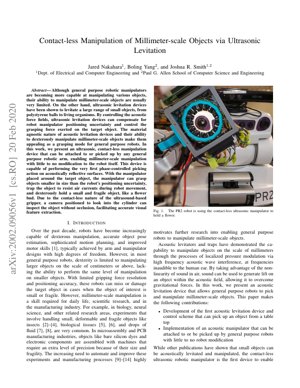
General purpose robotic manipulators face significant challenges when manipulating millimeter-scale objects due to limited gripping force resolution and positioning accuracy. This research presents an ultrasonic levitation device that enables contact-less manipulation of small objects, overcoming traditional robotic limitations.
Key Contributions
- First acoustic levitation device capable of picking objects from table tops
- Robust integration with general purpose robots requiring minimal modifications
- Phase-controlled picking action on acoustically reflective surfaces
- Enhanced visual inspection through contact-less manipulation
2. Technical Implementation
2.1 Acoustic Levitation Principles
Ultrasonic levitation operates through high-frequency acoustic wave interference, generating localized pressure fields that can counteract gravitational forces. The acoustic radiation force $F_{acoustic}$ acting on a particle can be described by:
$$F_{acoustic} = -\nabla U$$
where $U$ represents the Gor'kov potential, given by:
$$U = 2\pi R^3 \left( \frac{\langle p^2 \rangle}{3\rho c^2} - \frac{\rho \langle v^2 \rangle}{2} \right)$$
Here, $R$ is the particle radius, $p$ is acoustic pressure, $v$ is particle velocity, $\rho$ is medium density, and $c$ is sound speed.
2.2 Device Design and Integration
The manipulator features a cylindrical design with multiple ultrasonic transducers arranged in a phased array configuration. The device utilizes the method of images for acoustic field modeling, enabling precise control of the acoustic force fields.
Device Specifications
- Operating Frequency: 40 kHz ultrasonic
- Manipulation Range: Basin of attraction ~5-10mm
- Object Size: 0.5-5mm diameter
- Integration: Universal robot attachment
3. Experimental Results
3.1 Performance Metrics
The device successfully manipulated various millimeter-scale objects including polystyrene balls, electronic components, and delicate biological specimens like flower buds. The system demonstrated robust performance against positioning uncertainties up to ±2mm.
3.2 Visual Inspection Capabilities
The contact-less nature enables unobstructed camera views into the manipulation chamber, facilitating accurate visual feature extraction and real-time monitoring of delicate specimens.
4. Technical Analysis
4.1 Mathematical Formulation
The acoustic field is modeled using the method of images, accounting for reflective surfaces. The pressure field $p(x,y,z)$ from N transducers is given by:
$$p(x,y,z) = \sum_{i=1}^{N} A_i \frac{e^{-j(kr_i + \phi_i)}}{r_i}$$
where $A_i$ is amplitude, $k$ is wave number, $r_i$ is distance, and $\phi_i$ is phase shift.
4.2 Control Algorithm Implementation
class UltrasonicManipulator:
    def __init__(self, transducer_count):
        self.transducers = [Transducer() for _ in range(transducer_count)]
        self.basin_attraction = None

    def calculate_phase_shifts(self, target_position):
        """Calculate phase shifts for focal point at target position"""
        phases = []
        for transducer in self.transducers:
            distance = np.linalg.norm(transducer.position - target_position)
            phase = (distance % wavelength) * 2 * np.pi / wavelength
            phases.append(phase)
        return phases

    def grasp_object(self, object_position, grip_force):
        """Initiate grasping sequence with specified force"""
        phases = self.calculate_phase_shifts(object_position)
        self.apply_phases(phases)
        self.modulate_amplitude(grip_force)
5. Future Applications
This technology has significant potential in multiple domains:
- Medical Robotics: Non-contact manipulation of biological tissues and delicate surgical components
- Microassembly: Precision handling of electronic components and micro-mechanical parts
- Laboratory Automation: Automated handling of fragile specimens in biological research
- Additive Manufacturing: Contact-less positioning of materials in micro-scale 3D printing
Original Analysis
The research on ultrasonic levitation for robotic manipulation represents a significant advancement in micro-scale robotics. This work addresses a critical gap in general-purpose robotics by enabling manipulation of objects smaller than typical positioning uncertainties. The contact-less nature of acoustic manipulation provides distinct advantages over traditional grippers, particularly for fragile biological specimens and precision electronic components.
Compared to optical tweezers, which have been widely used for micro-manipulation in biological research (as demonstrated in studies from institutions like MIT and Stanford), ultrasonic levitation offers superior scalability and energy efficiency for millimeter-scale objects. The ability to manipulate objects on reflective surfaces, as achieved in this work, represents a substantial improvement over previous acoustic levitation systems that typically required specialized non-reflective platforms.
The integration with general-purpose robots follows the modular approach seen in successful robotic systems like ROS (Robot Operating System), enabling widespread adoption without extensive hardware modifications. This aligns with trends in modular robotics research from institutions such as Carnegie Mellon's Robotics Institute, where plug-and-play capabilities are increasingly emphasized.
The mathematical foundation, particularly the use of Gor'kov potential and method of images, provides a robust theoretical framework comparable to established physical models in acoustic physics. The phase-controlled approach demonstrates sophisticated signal processing reminiscent of phased-array radar systems, adapted for micro-scale manipulation.
Future developments could benefit from incorporating machine learning techniques for adaptive control, similar to approaches used in computer vision systems like those referenced in the CycleGAN paper for domain adaptation. The potential for swarm manipulation using multiple coordinated devices presents exciting possibilities for scalable micro-assembly systems.
6. References
- J. Nakahara, B. Yang, and J. R. Smith, "Contact-less Manipulation of Millimeter-scale Objects via Ultrasonic Levitation," arXiv:2002.09056v1 [cs.RO], 2020.
- R. W. Applegate et al., "Microfluidic sorting using ultrasonic standing waves," Lab on a Chip, vol. 5, pp. 100-110, 2005.
- A. Marzo and B. W. Drinkwater, "Holographic acoustic tweezers," Proceedings of the National Academy of Sciences, vol. 116, pp. 84-89, 2019.
- K. Dholakia and T. Čižmár, "Shaping the future of manipulation," Nature Photonics, vol. 5, pp. 335-342, 2011.
- M. A. B. Andrade et al., "Acoustic levitation and manipulation by a multi-transducer array," Review of Scientific Instruments, vol. 86, 2015.
- J. Zhu et al., "Unpaired Image-to-Image Translation using Cycle-Consistent Adversarial Networks," ICCV, 2017.
- S. J. Rupitsch, "Ultrasonic transducers for particle manipulation," in Piezoelectric Sensors and Actuators, Springer, 2019.