Table of Contents
1. Introduction & Overview
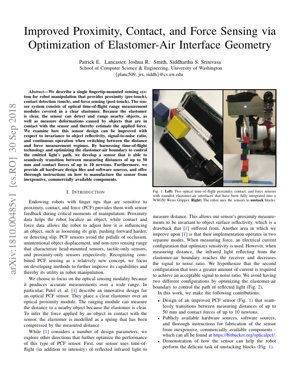
This work presents a significant advancement in robotic fingertip sensing by developing a single, integrated sensor capable of measuring Proximity (pre-touch), Contact detection (touch), and Force (post-touch)—collectively termed PCF sensing. The sensor addresses a critical gap in robotic manipulation, where traditional sensors are often limited to a single modality (e.g., tactile-only or proximity-only), leading to issues like occlusion or lack of pre-contact information.
The core innovation lies in combining an optical Time-of-Flight (ToF) ranging module with a clear, deformable elastomer cover. The clarity of the elastomer allows for proximity sensing, while its deformation under contact enables force estimation. The key improvement over prior work, such as Patel et al., is the optimization of the elastomer-air interface geometry (e.g., a rounded boundary) to control internal light reflections, thereby eliminating the need for separate operating modes and improving signal-to-noise ratio and invariance to object surface properties.
50 mm
Maximum Proximity Sensing Range
10 N
Maximum Measurable Contact Force
Single Mode
Seamless Transition Between Regimes
Open Source
Hardware & Software Publicly Available
2. Sensor Design & Methodology
2.1 Core Optical Sensing Principle
The sensor is built around commercial optical Time-of-Flight (ToF) modules (e.g., VL53L0X). These modules emit infrared (IR) light and measure the time for the reflection to return, providing direct distance measurement. Unlike intensity-based methods, ToF provides invariance to object surface reflectivity, a major drawback of the predecessor design by Patel et al.
2.2 Elastomer-Air Interface Geometry Optimization
The pivotal design parameter is the shape of the elastomer's outer surface. A flat interface causes significant internal reflections of the emitted IR light back to the receiver, saturating it when no external object is present. This forces operation in a low-sensitivity "distance mode" with high emitter current, degrading force measurement SNR.
The proposed solution is a rounded (curved) elastomer-air interface. As illustrated in Fig. 2 of the PDF, this geometry refracts the internally reflected light away from the receiver's field of view when no external target is present. This allows the sensor to operate in a single, optimized configuration with high SNR for both proximity and force sensing, enabling seamless transition.
2.3 Hardware & Fabrication
The sensor design is fully open-source. Key components include:
- Optical ToF sensor module(s).
- 3D-printed sensor housing.
- Clear silicone elastomer (e.g., Ecoflex 00-30), cast into the housing with the optimized rounded interface.
- Microcontroller for data acquisition.
3. Technical Details & Mathematical Model
Force estimation is based on modeling the elastomer as a linear spring. The ToF sensor measures the distance $d$ to the internal surface of the elastomer. When an object contacts and deforms the elastomer, the measured distance $d$ decreases. The force $F$ is estimated as:
$F = k \cdot (d_0 - d)$
Where:
- $k$ is the effective spring constant of the elastomer, determined empirically.
- $d_0$ is the baseline distance to the elastomer surface with no contact (i.e., its thickness).
- $d$ is the measured distance during contact.
4. Experimental Results & Performance
4.1 Proximity Sensing Performance
The sensor reliably detects objects within a 50 mm range. The use of ToF technology successfully eliminates the dependency on object reflectivity observed in prior intensity-based designs. The rounded interface prevents internal reflection saturation, maintaining high signal quality.
4.2 Force Sensing Performance
The sensor demonstrates a linear force response up to 10 Newtons. The calibration curve (Force vs. $(d_0 - d)$) is linear, validating the spring model. The single operating mode enabled by the optimized interface provides a superior signal-to-noise ratio compared to dual-mode designs.
4.3 Integrated Task Demonstration
The sensor's utility was demonstrated in a robotic unstacking task (Fig. 1, Right). Mounted on a WSG50 gripper, the sensors provided:
- Proximity: Guided the gripper to approach the stack without collision.
- Contact: Detected the moment of touch with the top block.
- Force: Enabled the gripper to apply a controlled, gentle force to lift the block without toppling the stack.
5. Key Insights & Contributions
- Unified PCF Sensing: A single, low-cost sensor modality that provides critical pre-, during-, and post-contact information.
- Interface Geometry as a Design Lever: Demonstrates that optical path control via mechanical design (rounded interface) can solve electronic and signal processing challenges (mode switching, SNR).
- ToF for Robustness: Adoption of Time-of-Flight over intensity measurement directly addresses a key robustness issue (reflectivity variance) in real-world environments.
- Open-Source & Accessible: Full public release lowers the barrier to adoption and replication in the research community.
6. Analysis Framework & Case Example
Core Insight, Logical Flow, Strengths & Flaws, Actionable Insights
Core Insight: The paper's genius isn't in inventing a new sensor, but in a brutally simple geometric hack that unlocks the full potential of commodity optical ToF chips for robotics. They identified that the major bottleneck for a unified PCF sensor wasn't the electronics, but the messy physics of light inside a squishy medium. By curving a surface, they turned a signal-processing nightmare into a clean, single-mode measurement stream. This is a classic case of solving a software/control problem with mechanical design—a lesson many roboticists forget.
Logical Flow: The argument is razor-sharp: 1) PCF sensing is vital for dexterous manipulation. 2) Prior optical designs (Patel et al.) were hamstrung by reflectivity dependence and dual-mode operation. 3) Our hypothesis: the dual-mode need stems from internal light reflections. 4) Solution: shape the elastomer to scatter internal reflections away. 5) Result: a single, robust, high-SNR mode for both proximity and force. The logic is airtight and elegantly demonstrated.
Strengths & Flaws: The strength is undeniable—simplicity, cost, and performance. It's a masterclass in minimalism. However, let's be critical. The linear spring model is a gross simplification. Elastomers like Ecoflex are viscoelastic; their response is rate-dependent and exhibits hysteresis. For slow, careful tasks like block stacking, it works. For dynamic manipulation (catching, slap), it will fail. The paper quietly acknowledges this by focusing on "delicate" tasks. Furthermore, the 50mm/10N specs, while practical, are not groundbreaking. The real value is in the integration and seamlessness, not the individual metrics.
Actionable Insights: For researchers: Stop treating sensing, mechanics, and control as separate silos. This work shows that cross-disciplinary optimization (optics + material geometry) yields the biggest gains. For industry: This is a blueprint for low-cost, robust tactile sensing in warehouse automation or collaborative robots. The open-source nature means you can prototype a functional gripper sensor in a week. The immediate next step should be replacing the linear model with a learned, data-driven model (a tiny neural network) to capture non-linear elastomer dynamics, following the trend set by works like "A Large-Scale Study of Vision-Based Tactile Sensing" from MIT. Combine this paper's elegant hardware with modern machine learning, and you have a winner.
7. Future Applications & Research Directions
- Advanced Material Models: Replacing the linear spring model with non-linear or data-driven models (e.g., neural networks) to account for viscoelasticity, hysteresis, and temperature effects for dynamic manipulation.
- Multi-Modal Sensor Fusion: Integrating this optical PCF sensor with other modalities, such as high-resolution vision-based tactile sensors (e.g., GelSight derivatives) for simultaneous macro-force and micro-texture perception.
- Miniaturization & Array Design: Developing dense arrays of these sensors on curved finger surfaces to provide rich spatial force and proximity maps, akin to an "optical skin."
- Application in Human-Robot Interaction: Deploying these sensors on collaborative robots (cobots) for safer and more responsive physical interaction, as they provide clear pre-contact awareness.
- Underwater or Dirty Environments: Exploring the sensor's robustness in non-ideal conditions, though the optical clarity of the elastomer may be a limiting factor requiring protective coatings or different wavelengths.
8. References
- Patel, R., et al. "A novel design of a proximity, contact and force sensing finger for robotic manipulation." IEEE Sensors Journal, 2017. (The predecessor work this paper improves upon).
- Lambeta, M., et al. "DIGIT: A Novel Design for a Low-Cost, Compact, and High-Resolution Tactile Sensor." IEEE International Conference on Robotics and Automation (ICRA), 2020. (Example of vision-based tactile sensing).
- Yuan, W., et al. "GelSight: High-Resolution Robot Tactile Sensors for Estimating Geometry and Force." Sensors, 2017. (Seminal work on optical tactile sensing).
- STMicroelectronics. "VL53L0X: Time-of-Flight ranging sensor." Datasheet. (The type of commercial sensor likely used).
- MIT CSAIL. "Tactile Sensing Research." https://www.csail.mit.edu/research/tactile-sensing (Authoritative source on state-of-the-art tactile perception).