Select Language

Multiband NFC for High-Throughput Wireless Computer Vision Sensor Network

A novel NFC system utilizing multiple ISM frequency bands to achieve high data rates for wireless coupling between vision sensors and processors in computer vision applications.
contact-less.com | PDF Size: 0.3 MB
Rating: 4.5/5
Your Rating
You have already rated this document
PDF Document Cover - Multiband NFC for High-Throughput Wireless Computer Vision Sensor Network

1. Introduction & Overview

This work proposes a novel Multiband Near-Field Communication (NFC) system designed to address the critical bottleneck of data transfer in wireless computer vision sensor networks. As vision sensors generate increasingly large volumes of high-definition data (e.g., 4K video streams), conventional wireless links like Bluetooth and WiFi Direct suffer from high latency in link establishment and limited, non-scalable bandwidth. The proposed system leverages multiple license-free ISM bands (e.g., 900 MHz, 2.4 GHz, 5.8 GHz) simultaneously to achieve high aggregate throughput, enabled by a simplified protocol and an All-Digital Transmitter (ADTX) implemented on an FPGA for rapid prototyping.

Key Insights

  • Problem: High-throughput, low-latency wireless coupling is needed between vision sensors and processors for applications like AR/VR and SLAM.
  • Solution: A multiband NFC system that parallelizes data streams across multiple RF bands.
  • Enabler: An All-Digital Transmitter (ADTX) design for fast implementation and potential energy efficiency.
  • Advantage: Faster link setup than Bluetooth/WiFi and a theoretically scalable data rate via bandwidth aggregation.

2. Core Technology & System Design

2.1. The Need for High-Speed NFC in Vision Systems

Modern computer vision, powered by machine learning, demands the transfer of massive datasets from sensors to processing units. While Bluetooth and WiFi offer high data rates, their protocols involve lengthy search and pairing phases (>10 seconds), degrading user experience for quick file sharing or real-time applications. Furthermore, their bandwidth is constrained by spectrum regulation. NFC, with its very short range (<3 cm), allows for the use of broader bandwidth at low power, complying with regulations while enabling a simpler, faster protocol suitable for a single dedicated TX-RX pair.

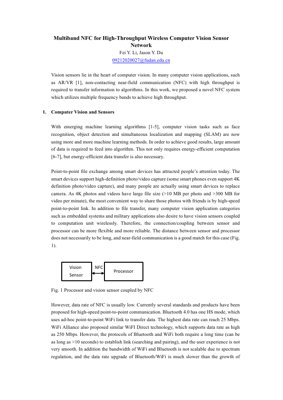
System Context: As shown in Fig. 1 of the PDF, the vision sensor and processor are coupled via an NFC link. A designed coupler and shielding are used to focus the RF field and minimize leakage.

2.2. Multiband RF Interconnect Architecture

The core innovation is the use of multiple ISM bands in parallel. The data stream is divided into multiple sub-streams. Each sub-stream is up-converted to a different, pre-defined ISM frequency band. These multiple RF signals are then combined using a power combiner [9] for transmission, as conceptually depicted in Fig. 3 of the PDF.

Key Principle: The aggregate data rate $R_{total}$ becomes the sum of the data rates on each band: $R_{total} = \sum_{i=1}^{N} R_i$, where $N$ is the number of bands used. This provides a pathway to scale throughput beyond the limit of any single band.

2.3. All-Digital Transmitter (ADTX) with FPGA

To facilitate rapid prototyping, the work adopts an All-Digital Transmitter (ADTX) design methodology proposed by Li et al. [10]. This approach implements the RF transmitter primarily through digital logic synthesis on an FPGA, drastically reducing design turnaround time.

Architecture: The transmitter (Fig. 4 in PDF) employs Sigma-Delta Modulation (SDM) and XOR-based mixing to convert baseband digital signals directly into a high-speed RF signal. This digital-intensive approach aligns with trends in software-defined radio and offers advantages in reconfigurability and potential power efficiency for specific modulation schemes.

3. Technical Analysis & Framework

3.1. Technical Details & Mathematical Formulation

The multiband transmission can be modeled as a parallel channel system. If each band $i$ has an achievable spectral efficiency of $\eta_i$ (bits/s/Hz) and an available bandwidth of $B_i$, the data rate for that band is $R_i = \eta_i B_i$. The total capacity is constrained by the aggregate bandwidth and the Signal-to-Noise Ratio (SNR) in each band, which is typically high for near-field links.

The ADTX's operation involves generating a high-frequency digital clock. The data is modulated using a scheme like BPSK or QPSK implemented in the digital domain. The XOR mixer acts as a digital multiplier, effectively performing: $RF_{out}(t) = D(t) \oplus CLK_{RF}(t)$, where $D(t)$ is the modulated data signal and $CLK_{RF}(t)$ is the RF carrier clock. The output is then filtered to suppress harmonics.

3.2. Analysis Framework & Conceptual Workflow

Case Study: Wireless Camera-to-Phone 4K Photo Transfer

  1. Trigger: User brings phone within 3 cm of a camera sensor module.
  2. Fast Link Setup: Simplified NFC protocol establishes a link in milliseconds (vs. seconds for Bluetooth).
  3. Data Segmentation: A 12 MB 4K photo file is segmented into, for example, 3 sub-streams.
  4. Parallel Transmission: Each sub-stream is up-converted to 900 MHz, 2.4 GHz, and 5.8 GHz bands, respectively, and transmitted simultaneously via the combined RF front-end.
  5. Reception & Combining: The phone's receiver separates the bands, down-converts each, and reassembles the original file.

This framework highlights the potential for "tap-and-go" ultra-high-speed data sharing, a significant user experience improvement.

4. Results, Discussion & Future Outlook

4.1. Expected Performance & Comparative Analysis

While the PDF does not present measured results, the expected advantages are clear from the architecture:

  • Data Rate: Potential to exceed the 250 Mbps of WiFi Direct by aggregating bands. A conservative estimate using three bands with 20 Mbps each yields 60 Mbps; more aggressive modulation could push it much higher.
  • Latency: Link establishment time is projected to be orders of magnitude faster than Bluetooth/WiFi, crucial for interactive applications.
  • Efficiency: The ADTX and short-range operation promise lower energy per bit compared to traditional far-field radios for the same throughput at very short distances.

Chart Concept (Fig. 2 & 3 Description): Fig. 2 illustrates the physical setup with a coupler and shielding ensuring efficient, contained near-field coupling. Fig. 3 is a block diagram showing two data streams being up-converted to different carrier frequencies (RF Signal 1 & 2) and then combined into a single output signal for transmission, visually representing the multiband multiplexing principle.

4.2. Application Prospects & Future Directions

Immediate Applications:

  • Instant HD media transfer between cameras, phones, and tablets.
  • Wireless docking stations for laptops/tablets with instant high-speed data sync.
  • Modular robotics and drones, where vision sensors can be wirelessly and quickly coupled to a central processor.

Future Research Directions:

  • Advanced Modulation: Implementing higher-order QAM on each band to increase spectral efficiency $\eta_i$.
  • Integrated Design: Moving from FPGA prototype to a custom ASIC for the ADTX to minimize size and power consumption.
  • MIMO-NFC Hybrid: Exploring multiple-input multiple-output (MIMO) techniques within the near-field to further multiply capacity.
  • Standardization: Proposing a new high-speed NFC standard to the NFC Forum or similar bodies to ensure interoperability.

5. References

  1. [1-5] Various references to machine learning algorithms in computer vision.
  2. [6-7] References on energy-efficient computation.
  3. [8] FCC regulations on ISM bands.
  4. [9] Reference on power combiner design.
  5. [10] Li et al., "An all-digital transmitter design methodology," relevant conference or journal.
  6. External Source: Goodfellow, I., et al. "Generative Adversarial Nets." Advances in Neural Information Processing Systems. 2014. (Cited as a foundational example of modern ML driving data demand).
  7. External Source: "IEEE 802.11 Standards." IEEE Website. (Cited as the governing standard for WiFi, highlighting its protocol complexity).

6. Original Expert Analysis

Core Insight

This paper isn't just about faster NFC; it's a strategic pivot to reclaim the short-range, high-density connectivity space that Bluetooth and WiFi have clumsily occupied. The authors correctly identify that the "pairing latency" of modern wireless standards is an architectural sin for seamless human-computer interaction. Their bet on multiband aggregation within the NFC's physical constraint is a clever hack—it bypasses the slow, political process of allocating new wideband spectrum by stitching together existing narrowband fragments. This is reminiscent of carrier aggregation in 4G/5G, but applied to a centimeter-scale problem. The choice of an All-Digital Transmitter (ADTX) is telling; it's a move towards a software-defined, FPGA/ASIC-driven physical layer, aligning with trends in open RAN and flexible radios, as seen in research from institutions like MIT's Microsystems Technology Laboratories.

Logical Flow

The argument flows logically from a well-defined pain point (slow, bulky wireless for vision data) to a principled solution. The logic chain is: Vision data is large and growing (4K/8K) → Existing standards have high protocol overhead → NFC's short range allows regulatory leeway for simpler protocols and broader effective bandwidth → But a single ISM band is still limited → Therefore, use multiple bands in parallel. The inclusion of the ADTX is a pragmatic enabler for research speed, not the core innovation itself. It allows them to test the multiband concept without getting bogged down in analog RFIC design, a smart MVP strategy.

Strengths & Flaws

Strengths: The concept is elegant and addresses a genuine market gap. The use of established ISM bands is pragmatically brilliant for regulatory compliance and rapid prototyping. The focus on user experience (fast connection) is a key differentiator often overlooked in pure PHY-layer research.

Critical Flaws: The paper is conspicuously silent on the receiver complexity. Simultaneously receiving and decoding multiple, potentially non-contiguous RF bands requires sophisticated filtering, multiple down-conversion paths, and synchronization, which could negate the power and cost savings promised by the simple TX. The interference management between self-generated bands (intermodulation) is also hand-waved. Furthermore, while they cite the ADTX work [10], the energy efficiency claims for high-throughput modulation schemes need validation; digital switching at GHz rates can be power-hungry. Compared to the meticulously documented trade-offs in a seminal hardware paper like the one for Eyeriss (an energy-efficient CNN accelerator), this work lacks concrete, measured results to back its promises.

Actionable Insights

For product managers in mobile or AR/VR: This research signals a potential future where "touch-to-share" means transferring a full movie in seconds, not just a contact. Start evaluating high-bandwidth, proximity-based data transfer as a core feature for next-gen devices.

For RF engineers: The real challenge isn't the transmitter. The research frontier here is in designing low-power, integrated, multi-band receivers with fast channel sensing. Focus on novel filter architectures and wideband low-noise amplifiers (LNAs).

For standard bodies (NFC Forum, Bluetooth SIG): Pay attention. This work highlights a user experience flaw in your current standards. Consider developing a new, ultra-fast, simple protocol mode specifically for very-short-range, high-throughput data bursts. The future of seamless connectivity lies in protocols that are invisible to the user.

In conclusion, this paper plants a compelling flag on a valuable piece of conceptual ground. It's a promising blueprint, but its ultimate success hinges on solving the more difficult receive-side and integration challenges that it currently glosses over.