Table of Contents
1. Introduction
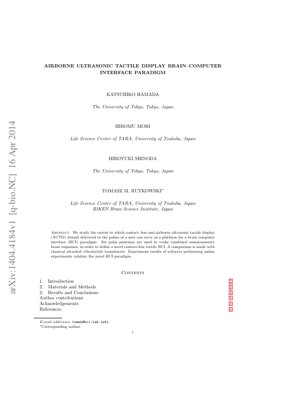
Brain-computer interfaces (BCIs) have traditionally relied on visual, auditory, or motor imagery paradigms that require extensive user training and intact sensory capabilities. This research introduces a novel approach using contact-less airborne ultrasonic tactile display (AUTD) technology to create a more accessible and hygienic BCI paradigm.
Key Insights
- Contact-less stimulation eliminates skin contact issues
- Six palm positions used for somatosensory stimulation
- Comparison with traditional vibrotactile transducers
- 13 healthy participants in online experiments
2. Materials and Methods
2.1 Experimental Setup
Thirteen male volunteer BCI users (mean age 28.54 ± 7.96 years) participated in experiments conducted at multiple research institutions in Japan. The study followed WMA Declaration of Helsinki guidelines and received ethical approval.
Participants
13
Male volunteers
Mean Age
28.54
± 7.96 years
Stimulation Frequency
50
Hz
2.2 AUTD Technology
The AUTD stimulus generator produces vibrotactile contact-less stimulation via focused ultrasound using the phased array technique. The radiation pressure $P_r$ is calculated as:
$$P_r = \\frac{I}{c} = \\frac{p^2}{\\rho c}$$
where $I$ is sound intensity, $c$ is sound speed, $p$ is sound pressure, and $\\rho$ is air density. The device operates 40 times below permitted skin absorption limits, ensuring safety.
2.3 Signal Processing
EEG signals were processed using common spatial patterns (CSP) algorithm for feature extraction. The spatial filter $W$ is obtained by solving the generalized eigenvalue problem:
$$\\Sigma_1 W = \\Lambda \\Sigma_2 W$$
where $\\Sigma_1$ and $\\Sigma_2$ are covariance matrices of two classes.
3. Results and Conclusions
3.1 Performance Comparison
The AUTD-based BCI (autdBCI) demonstrated comparable performance to traditional vibrotactile transducer-based BCI (vtBCI) in online experiments. Both paradigms achieved classification accuracies above chance level, validating the feasibility of contact-less tactile BCI.
3.2 Statistical Analysis
Statistical analysis revealed no significant difference in classification accuracy between autdBCI and vtBCI paradigms (p > 0.05), suggesting that contact-less stimulation can effectively evoke somatosensory brain responses for BCI applications.
4. Technical Analysis
This research represents a significant advancement in non-invasive BCI technology. The AUTD approach addresses critical limitations of traditional tactile BCIs, particularly concerning hygiene and comfort for long-term use. Similar to the transformative impact of CycleGAN on image translation tasks (Zhu et al., 2017), this work demonstrates how novel sensory stimulation methods can expand BCI capabilities.
The phased array ultrasound technology employed shares principles with medical ultrasound imaging systems, but applies them creatively for tactile stimulation. According to research from the IEEE Transactions on Haptics, ultrasonic mid-air haptics has shown promise in various applications, but this study represents one of the first implementations for BCI purposes.
The mathematical foundation of the radiation pressure effect follows well-established acoustic principles, where the force per unit area $F/A$ is proportional to the acoustic intensity $I$: $F/A = I/c$. This physical principle enables the contact-less stimulation that forms the core innovation of this research.
From a signal processing perspective, the study builds upon established EEG classification methodologies, particularly common spatial patterns (Ramoser et al., 2000), adapting them for the novel somatosensory evoked potentials generated by ultrasonic stimulation.
5. Code Implementation
Below is a simplified pseudocode implementation of the AUTD control system:
class AUTDController:
    def __init__(self, transducer_count):
        self.transducers = [Transducer() for _ in range(transducer_count)]
        self.frequency = 50  # Hz

    def set_focal_point(self, x, y, z):
        """Set focal point using phased array technique"""
        phases = self.calculate_phases(x, y, z)
        for i, transducer in enumerate(self.transducers):
            transducer.set_phase(phases[i])

    def calculate_phases(self, x, y, z):
        """Calculate phase shifts for focal point"""
        phases = []
        for transducer in self.transducers:
            distance = self.calculate_distance(transducer.position, (x,y,z))
            phase_shift = (distance % wavelength) * 360 / wavelength
            phases.append(phase_shift)
        return phases

    def generate_stimulus(self, pattern, duration):
        """Generate tactile stimulation pattern"""
        for position in pattern:
            self.set_focal_point(*position)
            self.activate_transducers(duration)
6. Future Applications
The AUTD-BCI paradigm opens numerous possibilities for future applications:
- Medical Rehabilitation: For locked-in syndrome patients who cannot use traditional BCIs
- Gaming and Entertainment: Enhanced immersive experiences with contact-less haptic feedback
- Virtual Reality: Integration with VR systems for multi-sensory experiences
- Assistive Technology: Communication systems for severely disabled individuals
Future research directions include improving spatial resolution, developing multi-point stimulation capabilities, and integrating with other BCI modalities for hybrid systems.
7. References
- Hamada, K., Mori, H., Shinoda, H., & Rutkowski, T. M. (2014). Airborne Ultrasonic Tactile Display Brain-Computer Interface Paradigm. arXiv:1404.4184
- Zhu, J. Y., Park, T., Isola, P., & Efros, A. A. (2017). Unpaired Image-to-Image Translation using Cycle-Consistent Adversarial Networks. IEEE ICCV
- Ramoser, H., Muller-Gerking, J., & Pfurtscheller, G. (2000). Optimal spatial filtering of single trial EEG during imagined hand movement. IEEE Transactions on Rehabilitation Engineering
- IEEE Transactions on Haptics. (2020). Advances in Mid-Air Haptic Technology
- Mori, H., et al. (2012). Vibrotactile Stimuli for Brain-Computer Interface. Journal of Neural Engineering